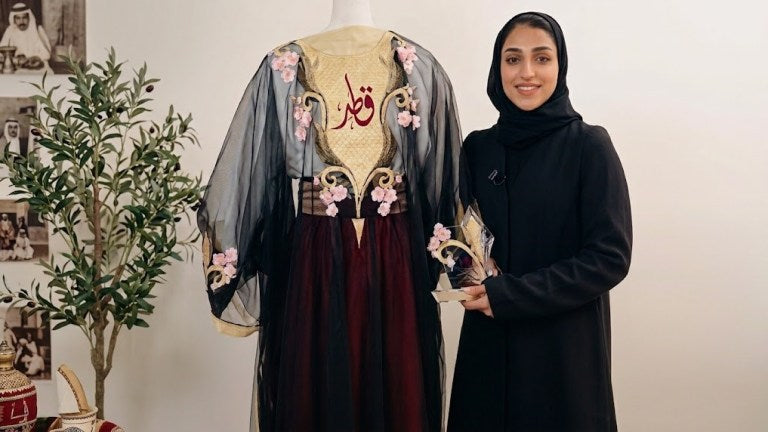
A design by Qatari designer Dana Al Mulla was worn by Team Qatar's female delegation at the Opening Ceremony of the Asian Games in Aichi-Nagoya, Japan — a piece that turned a national uniform into a cultural statement, built around Qatari heritage and finished with a deliberate nod to the host nation.
The 20th Asian Games opened on September 19 and run through October 4, hosting roughly 11,000 athletes from 45 countries and regions across 43 sports — only the third time Japan has hosted the Games, after Tokyo in 1958 and Hiroshima in 1994. Qatar's delegation numbers 427 members, including 243 athletes competing in 26 sports, with the tournament serving as a benchmark ahead of Doha's own turn as host of the 2030 Asian Games.
A design built on three symbols
The design goes beyond a delegation uniform — it encodes national identity into fabric, legible to a global audience with no prior context on Qatar. It draws on three references rooted in Qatari heritage:
-
The bisht — the black, gold-threaded cloak traditionally worn on occasions of honor — reimagined in flowing black tulle shot through with authentic zari gold embroidery, translating a garment of ceremony into one of sport.
-
The pearl — Qatar's economic and cultural lifeline before oil — worked into the piece as a nod to the country's diving heritage and the generations who built its identity from the sea.
-
The palm frond — a symbol of resilience and continuity, reflecting the endurance of the local landscape.
Layered over that foundation, sakura blossoms — Japan's most recognizable floral emblem — appear in soft pink across the shoulders and sleeves, using the host nation's own visual language to bring Qatar's story into it, rather than placing two cultures merely side by side. The most direct statement needed no metaphor: the word "Qatar" is embroidered across the bodice in Arabic calligraphy, so the country's name and identity are unmistakable wherever the delegation stands.
Design narrative as reported in Arabic-language coverage of the uniform's unveiling.
Why this is a bigger deal than a uniform
For anyone building Qatar's creative and entrepreneurial ecosystem, this moment is worth reading past the ceremony itself.
It's a rare, high-visibility platform for Qatari design talent. A uniform worn at an international multi-sport event is seen by broadcasters, delegations, and millions of viewers across Asia. That the piece worn on that stage came from a Qatari designer, rather than an international fashion house, points to a growing space for homegrown creative talent to represent the country on its own terms.
It shows heritage functioning as intellectual property, not just as folklore. The bisht, the pearl, and the palm frond are references most people in Qatar can name on sight. Turning them into a design language with commercial and diplomatic value is proof that heritage, handled with craft, becomes an exportable creative asset rather than a static reference point.
It builds the case for local creative commissioning. Every time a Qatari designer's work reaches a moment this visible, it strengthens the argument for the next brand, ministry, or event organizer to look locally first, rather than defaulting to international agencies by habit. That's the flywheel a creative economy needs: visibility earns commissions, commissions build track records, and track records justify bigger commissions next time.
For founders, designers, and creative entrepreneurs building in Qatar's ecosystem, this moment is a useful data point: the market for "Qatari story, told through craft" is real, it's being watched internationally, and it's still open for the next name to step into.


شارك:
دليل المبتدئين للتسويق الرقمي