

BuzzGage launches post-crisis student wellbeing recovery framework
- by Falak .
Doha, Qatar - BuzzGage, an education technology company operating in Qatar, has launched what it describes as the Middle East’s first post-crisis student wellbeing recovery framework, aiming to help schools and education systems better understand how crisis and prolonged disruption are shaping student experience across the region. According to BuzzGage’s website, the company focuses on measuring student wellbeing, engagement and social-emotional development through structured student voice and framework-aligned analysis.
Across the Middle East, many schools have worked to preserve learning continuity despite the long tail of crisis, displacement and uncertainty. But while attendance, test scores and classroom performance can show part of the picture, they often fail to capture the emotional and social conditions shaping how students learn, participate and recover. UNICEF notes that education settings in emergencies do more than deliver lessons: they can also provide stability, structure, and mental health and psychosocial support for children facing distress and disruption.
That is the gap BuzzGage says its new framework is designed to address. Rather than focusing on academic attainment alone, the initiative aims to give school leaders and ministries a structured, non-clinical view of how students are experiencing school after crisis.
The Post-Crisis Student Wellbeing Recovery Framework is built around anonymous student input collected during the school day through short, structured instruments. BuzzGage says responses are aggregated and analysed through its platform to identify patterns across cohorts, schools and wider systems, while preserving student anonymity. The company says the goal is to translate student voice into practical recovery priorities that school leaders and policymakers can act on over time.
The framework is positioned as a school-led planning and measurement tool rather than a clinical or diagnostic intervention. That distinction matters. UNICEF’s guidance on mental health and psychosocial support in education emergencies stresses the importance of structured, school-based support systems that can identify needs and guide action without turning schools into mental health treatment settings.
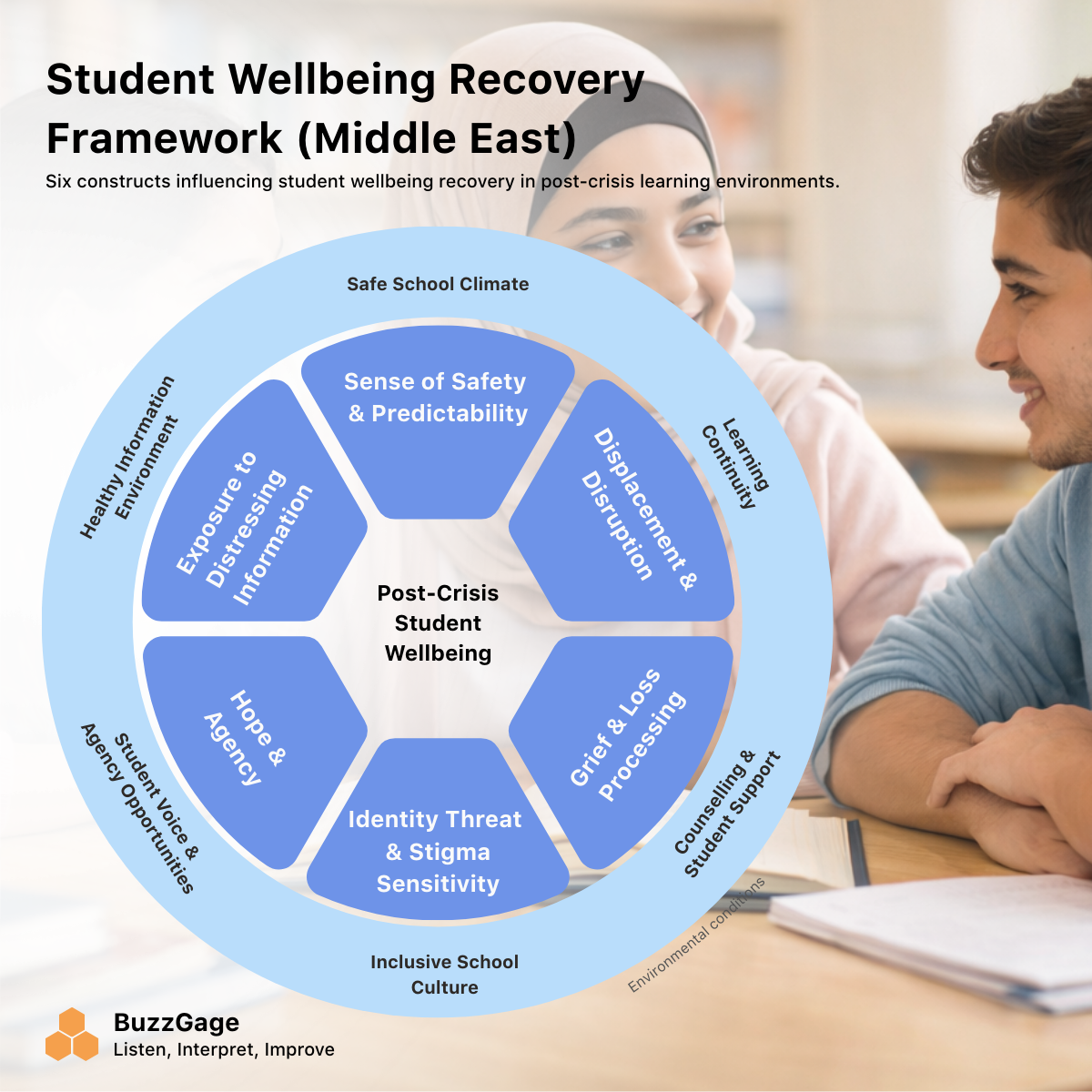
BuzzGage’s framework focuses on six non-clinical wellbeing dimensions that it says influence how students experience crisis and recovery:
Together, these dimensions are intended to help schools move beyond anecdotal impressions and build a more structured picture of what student recovery looks like in practice.
BuzzGage says its broader platform maps student voice to international frameworks including CASEL, OECD Learning Compass 2030, UNESCO Global Citizenship Education and whole-child development models. CASEL describes social and emotional learning as a process through which young people and adults develop healthy identities, manage emotions, build relationships and make responsible decisions. OECD’s Learning Compass 2030, meanwhile, frames student agency, responsibility and wellbeing as central to future-ready education. UNESCO’s GCED work similarly emphasizes empathy, belonging, responsibility and the skills needed to live together in complex societies.
In the Middle East and North Africa, UNICEF has also highlighted the importance of life skills, citizenship education and psychosocial support frameworks in contexts shaped by fragility, conflict and displacement, making the regional relevance of this kind of tool particularly clear.
BuzzGage says the initiative will launch first in Qatar before potentially expanding into other markets across the GCC and wider Middle East, including the UAE, Saudi Arabia, Lebanon, Jordan, Kuwait and Bahrain. On its website, the company identifies Qatar Science & Technology Park as one of the organisations in its partner ecosystem and describes its work as grounded in AI-enabled, research-aligned school improvement.
BuzzGage LLC (QFC No. 05042) is officially incorporated and licensed under the Qatar Financial Centre, underscoring its formal presence within Qatar’s business landscape and its positioning in the country’s wider innovation ecosystem.
“In times of crisis, what students carry into the classroom is often unseen, yet it directly shapes how they learn, engage, and recover,” BuzzGage founder Mohammed Chehab said in the launch announcement. “This framework is designed to make that invisible layer visible, so schools and systems can respond with clarity, responsibility, and care at scale.”
BuzzGage’s public materials describe Chehab as a repeat founder with experience across AI, edtech, fintech and e-commerce, leading the company’s product vision around student voice, framework-based interpretation and school improvement.
The launch comes at a time when education systems across the region are moving from immediate crisis response toward longer-term recovery planning. That shift is creating demand for tools that can help ministries and school leaders understand not just whether students are back in school, but how they are actually experiencing school.
If adopted at scale, frameworks like this could give education systems a shared language for recovery, one that is measurable, ethically designed and rooted in student voice rather than assumptions alone.
School leaders, ministries and education partners interested in the framework can contact BuzzGage at mc@buzzgage.org

Share:
HONOR devices now available with PayLater in Qatar
Want to Bid on Government Contracts in Qatar? Start Here.